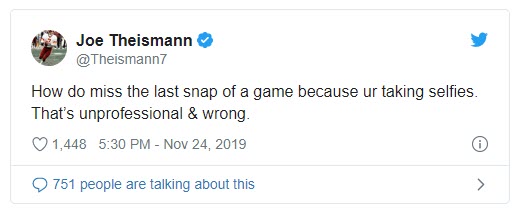
That’s Dwayne Haskins, the rookie quarterback for the Washington Redskins. The dude with the $14 million contract. He’s celebrating his first win as a starter by taking a selfie with fans. Actually, in the photo above, he’s celebrating his first presumed win. There were still two ticks left on the clock. The Redskins had just intercepted the ball. All they had to do was take a knee… but Haskins was too busy taking a selfie to trot out onto the field for the final play.
The Redskins interim coach (yes, it’s been a bad season) couldn’t track down Haskins. (Maybe he should’ve checked Instagram.) So he had to scramble and send the backup QB onto the field to seal the victory.
After the game, Haskins admitted that he thought the clock ran out on the interception. So maybe we should just chalk it up to the exuberance of youth. But seriously, it was only a three-point game at the time. Keep your head in the game until the game is officially over.
(AP Photo/Patrick Semansky)
Maybe I’m overthinking it. After all, with just a few seconds left, what could possibly go wrong?
To me, Haskins sideline antics are a symptom of a larger problem in the selfish/selfie world. Instead of being on the field with his teammates to celebrate his first ever win as an NFL starter, Haskins was hamming it up for the camera… “pics or it didn’t happen.”
I see it all the time at concerts too – people (of all ages, this isn’t an “OK Boomer” rant) whipping out their cell phones to capture video of a band’s biggest hit. Here’s an idea: keep your damn phone in your pants and experience that moment with your own eyeballs! Those memories will be much better than some shaky video footage with distorted audio.
But don’t just take it from me, take it from an expert on living life to the fullest:
Morgan Hentz is an all-universe volleyball player. Two-time All-American, and two-time NCAA champion with Stanford.
I worked with Morgan’s dad Mike at an ad agency eons ago. We still get together for the occasional happy hour, but those are few and far between, for reasons that will become patently obvious when you read this wonderful article about Morgan and the Hentz family on the Stanford Athletics website.
Morgan’s younger brother Louie had a cancerous brain tumor at age one. Louie and his mom, Kerin, spent a year at St. Jude’s in Memphis… yes, a full year… while Mike mostly stayed home with Morgan and her sister. Wrap your head around that for a moment: a mom separated from her young daughters, a father 500 miles away while his infant son was fighting for his life.
Then the other shoe dropped: at age 3, Louie was diagnosed with autism.
Louie does not interact through spoken language – other than simple wants and needs. He’s 16 and weighs 300 pounds because of his meds, and can be difficult to control physically. His life has been one of appointments and therapists. His development has been slow — hopeful on a good day. He is repeating some lines from familiar movies and videos, creating some optimism about brain development. But there’s no way to know.
Morgan is a superstar, but so is the rest of her family.
Long ago, Kerin and Mike learned to sacrifice things that other couples take for granted – nights and weekends away, dinners out, and even time with their other children. Instead, they’ve learned to roll with whatever happens and be prepared for whatever comes next.
Every day is a new challenge. Mike and Kerin have been playing at the highest level for 16 years. They’re world champs in the game that matters most.
“I feel like I would never wish what Louie had on anyone, but I think that because of my family and being able to make the most of the situation, I’ve learned a lot from him and my parents. They are the biggest role models in my life — the sacrifices they have made for our family. They have always put us kids first.”
I’m not talking about the “holiday season” (I’m a USDA Certified, Grade A Grinch about that nonsense).
I’m talkin’ ’bout the college basketball season. And in particular Xavier University basketball. As an alum, as a 25+ year season ticket holder, I love it — it gives me something to look forward to during the dreary days of winter. Even the cheesy hype videos give me goose bumps.
I used to just have a single season ticket, sitting with a few friends. But last year, I added another season ticket, so each game is also a chance to spend some quality time with one of my kids, or my wife, or a friend. The games have created some fantastic memories over the years…
Marty Brennaman, who has been the Cincinnati Reds play-by-play radio announcer for the past 46 seasons, will step away from the mic following this afternoon’s “titanic struggle” (that’s a Marty-ism) with the Milwaukee Brewers.
When I was 6, my family moved from New Jersey to Arkansas… sparing me the ignominy of being one of those obnoxious fans of the Yankees or Mets. With no geographic allegiance to a particular team, I was an MLB free agent fan.
In those pre-cable dark ages of the early 70s, all we had was the NBC Game of the Week (Curt Gowdy, Tony Kubek and Joe Garagiola) and the radio. I quickly latched onto the Cincinnati Reds, also known as The Big Red Machine. Rose, Bench, Morgan, Perez, Concepcion, Geronimo… they were my heroes.
The Reds flagship radio station was — and still is — 700 WLW-AM, a 50,000 clear channel station. The station’s signal covered dozens of states at night, including Arkansas. So I would tune in nearly every game. Marty joined in 1974 (replacing Al Michaels), teaming up with former teenage major league pitcher Joe Nuxhall.
Marty & Joe were the soundtrack to my baseball life. Marty’s signature victory cry of “… and this one belongs to the Reds!” has been the source of thousands of smiles over my lifetime.
Marty’s last call is today. They’re giving away transistor radios to kids who attend, which is certainly anachronistic in the streaming media/smartphone era, but it’s totally fitting for the generation that grew up with him.
Soccer had its moment in the sun yesterday. The U.S. Women’s National Team claimed their second consecutive Women’s World Cup title, giving them a record four titles overall.
Meanwhile the men’s team made the finals of the CONCACAF Gold Cup. (Don’t ask me what CONCACAF stands for – I think it’s a coffee brand.) They lost to Mexico, 1-0, but hey, they made the finals!
Mmm, that’s some mighty tasty Concacaf!
Now, most of America will shrug its collective shoulders, yawn, and go back to watching all the other sports for a few years. Yes, I know that football (the kind actually played with the foot) is “the beautiful game” and that it’s wildly popular in nearly every other corner of the globe. And yes, I know it’s picking up steam stateside… including here in Cincinnati, where FC Cincinnati, a newly-minted member of Major League Soccer, regularly draws crowds in excess of 25,000. Oh, and Rose Lavelle, who scored that beautiful goal for the USA Women yesterday? She’s from the ‘nati!
https://twitter.com/i/status/1147906367383977984
Still, something seems to be missing… a certain je ne sais quoi. Maybe it’s the traumatic brain injuries and consistent maimings that happen in American football. The interminable wait between pitches of baseball. The meaningless regular season of the NHL… or the meaningless regular season AND meaningless first three quarters of every game in the NBA. Maybe it’s because it doesn’t provide a handy excuse for taking a nice three-hour nap every Sunday like professional golf.
My college buddy Tom always used to claim “soccer is a communist sport” because it could end in a tie.
Roll tied!
(He still claims this, even though both his daughters got full-ride scholarships to SEC schools for… you guessed it… soccer!) But after watching the women’s semifinals and final, I know the real problem: “stoppage time.”
Stoppage time (also called injury time) is the time added on at the end of each half at the discretion of the referee.
What other sport has such a ridiculous and mysterious method for running (or not running) the clock? Can’t they just stop the clock anytime there’s an injury? Heck, I’ve worked the scoreboard at more than my fair share of kiddie basketball games, I’ll show ’em how it’s done.
We love two-minute drills and buzzer beaters, and soccer cheats us out of this by making the timing of the game rather random, and by not showing the crowd exactly how much time is left in the contest.
Until they fix stoppage time, soccer will be a sport whose time will never come in the U.S.
Yesterday, Rafael Nadal beat Dominic Thiem in the French Open final, becoming the first player to win the same Grand Slam 12 times. He’s clearly the “King of Clay” but he has 18 Grand Slam titles overall, so he’s not a one-trick pony.
As great as he is, “Rafa” has spent most of his career living in the shadow of Roger Federer. It would be easy to be a tad bit jealous. But now, at age 33, Nadal could conceivably catch or even surpass the 20 Grand Slam titles of the 37-year-old Federer. When he was asked about that possibility, his response was beautiful:
“I am not very worried about this stuff, no? You can’t be frustrated all the time because the neighbor has a bigger house than you or a bigger TV or better garden. That’s not the way that I see life.”
Kevin Sullivan on War… why? And now what?: “I read your post Damian and I like it very much. As we move from a Saturday morning headline of…” Mar 3, 09:22
Damian on Smartphones are making us dumb.: “Thanks for (not) reading the post, Kevin. And thanks for mentioning several other formats (article, essay, poem) that can train…” Feb 23, 19:55
Kevin on Smartphones are making us dumb.: “You know I didn’t read your post because I don’t need to. The lack of reading of all generations reveals…” Feb 23, 10:32















You done said…