Thank goodness the powers that be in college football have created a playoff system. Now, instead of the same ol’ same ol’, we get to enjoy a wide variety of teams vying for the national championship. Let’s see, there’s Alabama, and Clemson, and… welp, that pretty much sums it up.
Since the College Football Playoff started in 2014, the “Final 4” has consisted of: Alabama (every stinkin’ year), Clemson (every year but one), Oklahoma (3 years), Ohio State (twice), and a cameo by five other randos. The past three championship games have been ‘Bama vs. Clemson. This year, in a shocking turn of events, the final game tomorrow night is… wait for it… ‘Bama vs. Clemson.
ESPN tries their best to hype the living daylights out of it, but fatigue has set in. Someone wake me when it’s over. Actually, strike that… don’t wake me when it’s over, because I’ll be fast asleep long before the game ends, and I don’t really care who wins.
Another college hoops season has begun, bringing joy to millions of fans (myself included).
But there’s a seamy underbelly to sport, and the kids that play are merely pawns in a high stakes game that reaps billions for the NCAA. Yes, they get a scholarship, but that’s chump change compared to the money in play. Check out this New York Times article from a few months ago to read about one kid’s sad saga.
Brian Bowen Jr. (Photo: Gregory Payan/Associated Press)
A few excerpts below highlight the hypocrisy… bold emphasis is mine:
Playing in a gilded arena — the KFC Yum! Center — with luxury boxes and bars in the concourses that serve bourbon and other hard liquors, Louisville basketball has generated more than $45 million in annual revenue in recent seasons.
According to the government’s case, $100,000 is what it took to lure Bowen to Louisville and its Hall of Fame coach, Rick Pitino. Only $19,500 was actually paid to anyone — an amount equal to one-quarter of 1 percent of Pitino’s annual salary, $7.8 million.
Brian Bowen Jr. is not a defendant; he appears to have been a bystander.
After Louisville said he would not be allowed to play there, he transferred to the University of South Carolina — only to be told later by the N.C.A.A. that he could not play there, either. In that organization’s view, he seems to be irredeemably tainted. At 19 years old, he was a hoops pariah.
In court documents, prosecutors quoted the N.C.A.A. rule book extensively, and in doing so, called attention to stated principles that sounded antiquated, if not outright absurd. “Among the N.C.A.A.’s core principles for the conduct of intercollegiate athletics is a directive that ‘student-athletes shall be amateurs in an intercollegiate sport,’” the criminal complaint says, and that “‘student-athletes should be protected from exploitation by professional and commercial enterprises.’”
It was a curious claim, given that the N.C.A.A. — the Indianapolis-based nonprofit that governs college sports — is not just an enormous commercial enterprise but arguably an exploitive one. In the fiscal year that ended in 2017, the organization surpassed $1 billion in revenue for the first time. A majority of its income, $761 million, came from television rights to the season-ending basketball tournament popularly known as March Madness, an annual payment that increased to $869 million in 2018. The contract with CBS and Turner Sports stretches to 2032 and has an overall value of almost $19.6 billion.
That money, though, is just a fraction of what college athletes generate in football and men’s basketball. (The major college football programs essentially seceded from the N.C.A.A. when they formed the highly lucrative Bowl Championship Series in 1998, but their players still compete under the N.C.A.A.’s amateurism rubric.) Their labor is responsible for revenue that flows directly to their universities from a range of sources, including ticket sales, donations from wealthy boosters, in‑stadium advertising, conference broadcast rights and so-called shoe deals in which Nike, Adidas and Under Armour pay for the right to outfit teams — thereby turning ostensibly amateur athletes into human billboards.
Until the kids that are the “product” peddled by the NCAA get a bigger slice of the pie, they are playing a losing game.
My youngest kid plays soccer for the junior high team at his school. This past weekend, they won the city tournament, capping off an undefeated season. The finals came down to penalty kicks, and his team’s goalie, who is also our carpool buddy for practices, made a great leaping block of one PK to seal the win.
My son also played for the squad last year, as a 7th grader, and they won the tourney that year too. Which is certainly exciting, but it isn’t the be-all and end-all. Can you pick him out of the photo below?
Probably not. Because it’s a team sport. And the life lessons that come from that are what really matter. Last year, he didn’t get much playing time. Even this year, as an 8th grader and one of only five returning players, he wasn’t a starter. Because that’s how life works: nothing is handed to you. You have to work hard, get better, earn it. Which he did. Besides, a player can lead without being the leading scorer — he excelled at that.
The team’s practice jerseys have “Team over Self” written on the back. A not-so-subtle reminder of how to play.
I’m happy for the team, but not because they’re “champs”… because they’re a great group of kids who get along well with each other. Long after the trophies are collecting dust in a corner of the basement, the friendships he’s formed will remain. That’s a much bigger win in my book.
A couple of days ago, NBA player (and Xavier alum) David West announced his retirement after a very productive 15-year career.
He didn’t have the marquee value of some of his single-name counterparts in the pros (Kobe, Shaq, LeBron, etc.) but he was a two-time All-Star who had an extremely productive career. Check out the stats below:
He was a pro’s pro, a true warrior, and someone who made everyone else on the team better. A couple of years ago, he joined the Golden State Warriors for the veteran minimum salary when he could’ve gotten much more elsewhere. Because “you can’t take it with you.”
https://twitter.com/i/status/1035220605656870913
He also had passions beyond the b-ball court. This Washington Post article is a nice tribute to his many talents.
Scott Van Pelt sums up David West’s career and his ethos beautifully in this One Big Thing segment:
And we care deeply – waaay too deeply – about rankings and ratings. The top song on the charts.
Music was better back then…
The Fortune 500. The highest-grossing movie. The most-watched TV show. The most views or “likes” or “shares” on social media. The highest-ranked football team. The five-star basketball recruits.
We do comparisons all the time, trying to determine who is better…. and who is the best.
But Seth Godin is trying to help us reframe that obsession. (I know I write/rave about Seth a lot, but the man’s a genius.) Here’s a post from his blog earlier this week:
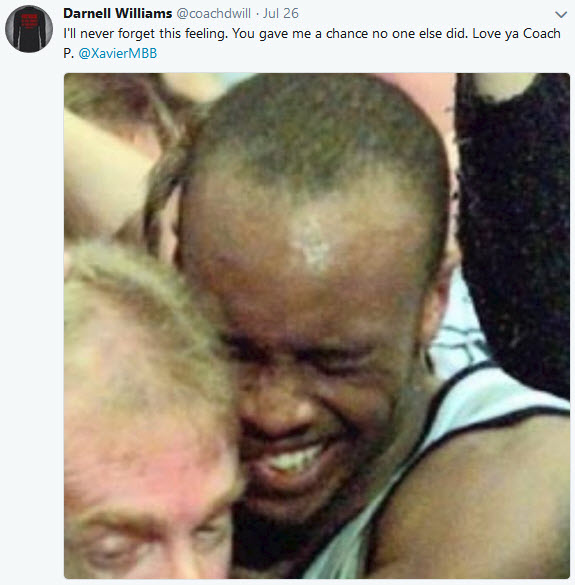
11 years and two days ago, the world lost a great teacher. He also happened to be a heck of a college basketball coach. No doubt he would want them listed in that order: teacher first, coach second.
His name was George Edward Prosser, but everyone called him Skip. He joined Xavier as an assistant coach under Pete Gillen way back when I was in school there, and later went on to become head coach at Loyola of Maryland, Xavier, and Wake Forest. He took all three teams to the NCAA tournament, and had a top five recruiting class coming in when he died of a heart attack on July 26, 2007, after jogging around the Wake Forest campus.
An avid reader and lifelong student, Skip was just as likely to wax rhapsodic about Thoreau or James Joyce as he was to talk about a full-court press. He was always humble, but he did pride himself on passing along life lessons to his student-athletes. His favorite quote was from Ralph Waldo Emerson:
“Our chief want in life is someone who shall make us do what we can.”
As Skip said, “I thought that was a powerful statement that we need to be around people who challenge us to be as good as we can be.”
On the day Skip returned to Cincinnati to take over as head coach at Xavier, I was dropping off a friend at the airport and saw Skip in the terminal. I went up to him, introduced myself as a Xavier alum, and said “welcome back to Cincinnati.” He replied, “thanks, it’s good to be back.”
This is what he said about returning to Xavier in 1994 to replace Gillen after serving as head coach for one year at Loyola (Md.): “I felt like I was coming home. Xavier wasn’t just a job for me. It was my first opportunity to coach at a collegiate level. I loved the city. Bellarmine was my parish. It was my church, my school. It was a town I considered my home. The minute I left Loyola, I felt great about being back at X.” (Source: this Cincinnati Enquirer article)
A year later, I started working at the ad agency that handled the Xavier b-ball account, and went to a kickoff meeting with Xavier’s associate AD and Skip. He was kind, gracious, humble, funny, totally unassuming and completely engaged. His AD at Loyola, Joe Boylan, said Prosser was “a renaissance man coaching basketball” and that’s a great description.
Skip left this world too soon, but his lessons are still with us.
On July 26, 2007, George Edward “Skip” Prosser, head basketball coach of the Wake Forest Demon Deacons, passed away. Only 56 years old, Prosser’s death shook college basketball and the sports world in general. Widely revered in coaching circles, he was one of those individuals about whom you never heard a bad word spoken.
Fully living up to the reputation of a teacher on and away from the court, Prosser was beloved by the players he coached. During an interview with The Seth Davis Show, Chris Paul, who played for Prosser from 2003-05, discussed the immense impact his college coach had on his daily life.
“For me, it’s funny. You think about some people that you’ve known your whole life and they don’t necessarily make an imprint on your life,” Paul told Davis. “I knew coach for all of four years, and I think about the imprint that he had on my life.”
Diving deeper, Paul offered up a couple maxims that he learned from his late coach.
“The words that he said. He used to say, ‘Never delay gratitude.’ That was one of his favorite sayings. ‘If you can’t be on time, be early.’ Aside from what he taught me about the game of basketball, he taught me about life and about being a man.”
“Someone asked me as I was leaving, what do I want people to remember?” Prosser said. “It would make me happy if they thought I stood for what Xavier stands for. That was my challenge and my charge all the time, to stand for what Xavier stands for.”
“Coaching isn’t wins and losses,” Prosser said. “It’s teaching. That’s the reason I got into coaching and the reason I’ve stayed in coaching. I hope that I remain in the business of education.”
Kevin Sullivan on War… why? And now what?: “I read your post Damian and I like it very much. As we move from a Saturday morning headline of…” Mar 3, 09:22
Damian on Smartphones are making us dumb.: “Thanks for (not) reading the post, Kevin. And thanks for mentioning several other formats (article, essay, poem) that can train…” Feb 23, 19:55
Kevin on Smartphones are making us dumb.: “You know I didn’t read your post because I don’t need to. The lack of reading of all generations reveals…” Feb 23, 10:32












You done said…